
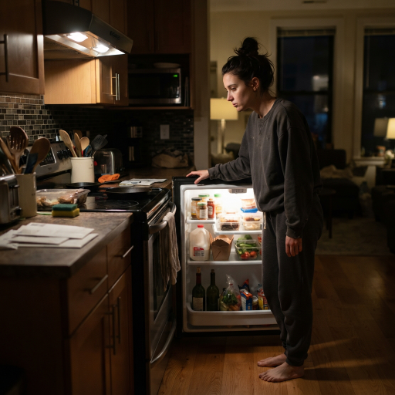
You open the fridge at six in the evening, tired, hungry, and completely unmotivated to cook anything. This is usually the moment meal planning advice fails you, because most of it assumes you actually enjoy being in the kitchen.
If you are wondering how to start meal planning when you hate cooking, the good news is that you do not need to enjoy cooking to benefit from a plan. You just need a different kind of plan, one built around effort, not enthusiasm.
Most meal planning content is written by people who find chopping vegetables relaxing.
That is simply not universal. Plenty of capable, organized people find cooking tedious, and no amount of pretty recipe photography changes that. What actually helps is a system that respects your real energy levels instead of asking you to fake an interest you do not have.
Why Traditional Meal Planning Feels Overwhelming
Standard meal plans often assume three things: that you enjoy trying new recipes, that you have time to prep multiple components, and that cooking itself feels like a reward rather than a chore.
When none of those are true for you, a normal plan collapses within a week. You end up ordering takeout, feeling guilty, and abandoning the whole idea.
In my experience, the failure point is rarely the planning itself. It is the assumption that planning has to include ambitious cooking. Once you remove that assumption, meal planning becomes much more sustainable.
Plan for Effort, Not Excitement
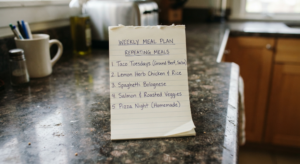
Instead of planning meals you think you should want to make, plan meals you will actually make on a tired Tuesday. That means being honest about your baseline energy, not your aspirational energy.
A realistic plan accounts for the version of you that just got home from work, not the version of you that watches cooking videos on a Sunday afternoon. Also read How to Make a Weekly Meal Plan From Scratch: A Complete System.
One approach I find particularly practical is separating meals into three categories: no cook, minimal cook, and one pan. If every meal in your rotation fits into one of these categories, you remove the guesswork of deciding what counts as too much effort in the moment.
No cook meals rely on assembly rather than cooking. Think rotisserie chicken with pre washed salad, hummus with vegetables and pita, or yogurt with fruit and granola.
Minimal cook meals involve one step, such as boiling pasta or microwaving rice, then combining it with something already prepared.
One pan meals use a single pan or sheet tray so cleanup does not become its own barrier to eating.
Reducing Decision Fatigue
A significant amount of resistance to cooking is not really about cooking. It is about deciding. Standing in front of a fridge trying to invent a meal from scratch is mentally exhausting, and research on decision making backs this up.
A conceptual analysis of decision fatigue published in the Journal of Health Psychology found that repeated decision making can impair a person’s ability to make trade offs and often leads to passive or avoidant choices. That tracks with what many people experience at dinnertime: it is not laziness, it is depletion.
The fix is to make fewer decisions overall. A short, repeating rotation of meals removes the need to invent something new every single day. You are not choosing from an infinite menu, you are choosing from five or six options you already know you can make with minimal effort.
Building a Low Effort Meal Rotation
Start with five meals you genuinely do not mind making, even on a bad day. Not meals you think are impressive, meals you can tolerate repeating. Write them down. This becomes your rotation.
A realistic rotation might include:
- Sheet tray chicken thighs with frozen vegetables
- Scrambled eggs with toast and fruit
- Store bought soup with bread and cheese
- Pre cooked shrimp with bagged salad and dressing
- Pasta with jarred sauce and a bag of spinach stirred in
None of these require skill. All of them can be on the table in twenty minutes or less, and several require no real cooking at all.
Using Convenience Foods Intelligently
There is nothing wrong with rotisserie chicken, frozen vegetables, canned beans, or pre washed greens. These are not failures of meal planning, they are tools. The goal is to reduce the number of raw ingredients you need to transform into food.
Look for convenience foods with short ingredient lists and minimal added sugar or sodium where possible, but do not let perfect nutrition become another barrier. A frozen vegetable side is still a vegetable.
Leftovers and Batch Preparation, Kept Simple
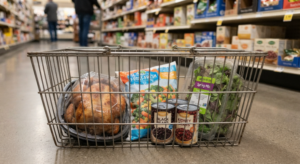
You do not need to batch cook five separate dishes on a Sunday. That is exactly the kind of ambitious prep that fails for people who dislike cooking. Instead, cook slightly larger portions of the one or two meals you are already making, and plan to eat the extra portion the next day.
For food safety, cooked leftovers are generally best used within about four days when refrigerated properly. USDA guidance on food product dating notes that cooked leftovers should be safe, wholesome, and of good quality when handled properly and kept at 40 degrees Fahrenheit or below. Keeping this rough timeline in mind helps you plan leftovers without overthinking it.
What to Do When Cooking Feels Impossible
Some days, even minimal cook meals feel like too much. Build a short list of true backup options for those days: cereal for dinner, a frozen meal you actually like, or a sandwich. Having this list decided in advance means you are not negotiating with yourself at seven in the evening.
A Sample Low Effort Weekly Meal Plan
Monday: Sheet tray chicken thighs and frozen broccoli
Tuesday: Scrambled eggs, toast, fruit
Wednesday: Leftover chicken and broccoli
Thursday: Store bought soup and bread
Friday: Pasta with jarred sauce and spinach
Saturday: Rotisserie chicken salad kit
Sunday: Backup night, whatever requires the least effort
This plan repeats often, requires very little variety, and still gets a meal on the table every day.
Illustrative Example
Consider a fictional reader, Maya, who works long shifts and has always found cooking draining rather than enjoyable.
Instead of trying a new recipe each night, she picked four meals she could tolerate on repeat and grocery shopped for exactly those ingredients each week.
Within a month, her grocery bill dropped because she stopped buying ingredients for meals she never actually made, and her weeknight stress dropped because dinner stopped being a decision.
CONCLUSION
Learning how to start meal planning when you hate cooking is really about lowering the bar until it matches your real life, not an idealized version of it.
A short rotation of low effort meals, a handful of convenience foods, and a backup plan for bad days will get you further than any elaborate weekly menu ever could. You are allowed to plan meals without loving the process of making them.
FAQS
Do I need to learn to cook to meal plan successfully?
No. Meal planning is about deciding what you will eat in advance. It does not require cooking skill, only a repeatable list of low effort meals.
How many meals should be in my rotation if I hate cooking?
Five to seven meals is usually enough. A smaller rotation reduces decision fatigue and keeps grocery shopping simple.
Is it okay to rely on convenience foods for meal planning?
Yes. Rotisserie chicken, frozen vegetables, canned beans, and pre washed greens are practical tools, not shortcuts to feel guilty about.
What if I do not feel like cooking even the easy meals?
Keep a short backup list of true no effort options, such as cereal, a frozen meal, or a sandwich, so you are never deciding from scratch on a hard day.
How long can I safely keep leftovers in the fridge?
Cooked leftovers are generally best used within about four days when stored at 40 degrees Fahrenheit or below.
Will low effort meal planning still save me money?
Often yes, because a repeating rotation reduces impulse takeout orders and prevents buying ingredients for meals you never end up making.
Can this approach work for a whole household, not just one person?
Yes. The same low effort categories, no cook, minimal cook, and one pan, can be scaled up in portion size for a family without adding cooking complexity.