
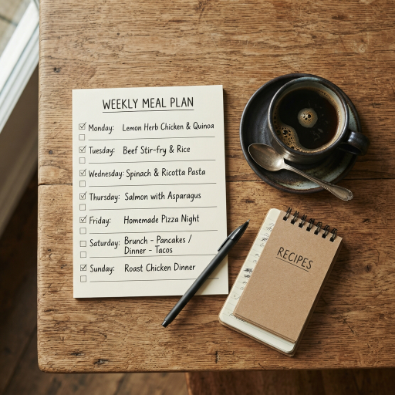
You open the fridge at six in the evening, stare at three half used ingredients, and end up ordering takeout again. That cycle is exactly why most beginners give up on meal planning before they ever really start.
It feels like it should be simple, yet somehow the plan falls apart by Wednesday. If that sounds familiar, this guide on meal planning for beginners step by step is built for you.
It skips the theory and gives you an actual framework you can use this week.
What Meal Planning Actually Means
Meal planning is simply deciding, ahead of time, what you will eat over a set period and matching that decision to what you buy and cook.
It is not a rigid diet plan, and it does not require spreadsheets or expensive apps. At its core, it is a way of removing daily decision fatigue so that dinner is not a last minute scramble.
Why Beginners Struggle at First
Most new planners try to plan too much, too perfectly, too soon. They map out every meal for thirty days, buy specialty ingredients they will only use once, and then feel defeated when life interrupts the plan.
In my experience, the beginners who succeed are the ones who start small: one week, a handful of meals, and room for mistakes.
Step 1: Choose How Many Meals to Plan

Do not plan every single meal right away. Start with dinners only, since that is usually the meal that causes the most stress. Once dinners feel manageable, add lunches, then breakfasts if needed.
Step 2: Check What Is Already In Your Kitchen
Before choosing any recipes, open your fridge, freezer, and pantry. Note what needs to be used soon. This single habit prevents duplicate purchases and reduces food waste.
The Environmental Protection Agency recommends checking what you already have before shopping, since it makes it far more likely you will actually cook and eat what you buy.
Step 3: Choose Your Meals
Pick meals that share ingredients where possible. If you buy a bag of spinach, use it across two or three meals instead of one.
Choose a mix of quick meals for busy nights and slightly more involved meals for days when you have time.
Step 4: Build a Realistic Grocery List
Write your list by grouping items the way your store is organized: produce, proteins, dairy, pantry. This alone speeds up shopping and reduces impulse buys. Only add what your chosen meals actually require.
Step 5: Estimate Portions Honestly
New planners often overestimate how much they will cook and eat. Think in terms of realistic servings for your household, not the recipe’s default serving size, which is frequently written for four people even when you are cooking for one or two.
Step 6: Organize Meals By Day, Not By Rule
Assign meals loosely to days based on your schedule, not in a fixed order. Busy days get the fastest meals. Slower days get the ones that take more effort. This flexibility is one reason a plan actually survives a real week.
Step 7: Avoid Overplanning
A common beginner mistake is planning seven completely different dinners. Instead, plan five or six, and leave one night open for leftovers or a simple backup meal.
One approach I recommend is picking a repeatable meal you enjoy and treating it as your default safety net.
Step 8: Handle Leftovers On Purpose
Decide in advance which meals will become tomorrow’s lunch. This turns leftovers into part of the plan instead of an afterthought that gets forgotten in the back of the fridge.
Step 9: Adjust As You Go
Your first plan will not be perfect, and that is fine. If a meal did not work, swap it next week. Meal planning is a system you refine, not a test you pass or fail.
A Simple Beginner Example
Monday: pasta with a simple vegetable sauce. Tuesday: sheet pan chicken and roasted vegetables. Wednesday: leftovers from Tuesday. Thursday: rice bowls with beans and whatever vegetables are left.
Friday: a quick omelet or breakfast for dinner night. This kind of rotation is intentionally simple, and that simplicity is exactly what makes it sustainable.
Real World Example: A Practical Approach to Weekly Meal Planning
Michigan State University Extension published a practical breakdown of how households can approach meal planning without a rigid formula.
Their guidance points out that thinking about servings and portion sizes should shape both the meal plan and the grocery list, and that treating your pantry, refrigerator, and freezer as a personal grocery inventory helps stretch a food budget further.
They also note there is no single correct order for the process, which mirrors what most beginners eventually discover for themselves: the system only works if it fits your actual routine.
Making the System Sustainable
The goal is not a perfect plan. The goal is a plan you will still be using in two months. Keep a running note of meals your household actually enjoyed, so future weeks take less effort to plan. Over time, this becomes a rotation you can lean on instead of starting from zero every Sunday.
Common Beginner Mistakes to Avoid
Planning meals you have never cooked before for every night of the week. Buying ingredients for one recipe that will not be used again.
Ignoring your actual schedule when assigning meals to days. Skipping the pantry check and duplicating what you already own.
Conclusion
Meal planning for beginners step by step does not need to be complicated. Check what you have, choose a manageable number of meals, build a focused grocery list, and stay flexible when the week does not go exactly as planned.
Start with one week, adjust what did not work, and the process gets easier every time you repeat it.
FAQs
Is meal planning hard for beginners?
It can feel overwhelming at first, but starting with just five dinners a week rather than every meal makes the process far more manageable.
How many meals should a beginner plan at once?
Most beginners do best planning five to six dinners, leaving room for leftovers or a simple backup meal.
Do I need an app to start meal planning?
No. A notebook or the notes app on your phone works fine while you learn the basic system.
What should I check before writing a grocery list?
Check your fridge, freezer, and pantry first so you do not buy duplicates or ingredients that will go to waste.
How do I stop overbuying at the grocery store?
Shop with a specific list built from chosen meals, and group items by store section to avoid impulse additions.
What if my meal plan does not work out during the week?
Adjust it. Swap a meal, use leftovers differently, or move things around. The plan should adapt to your week, not the other way around.
How long does it take to get good at meal planning?
Most people find a rhythm within four to six weeks of consistent practice, once they know which meals their household actually enjoys repeating.