

Typing “plan my meals for the week” into an AI chat tool takes about ten seconds. Turning what comes back into a plan you will actually follow takes a bit more thought.
Learning how to use AI to plan your weekly meals is less about the technology itself and more about knowing what to ask for, what to double check, and where your own judgment still needs to lead.
This guide is meant to be educational rather than promotional. AI tools can be genuinely useful for meal planning, but they are also imperfect, and treating their output as a finished plan without review can lead to unrealistic shopping lists or repetitive, poorly balanced meals.
What AI Can Actually Help With
AI tools are good at generating structure quickly. Given a few preferences, they can turn a vague idea like “something with chicken and rice” into a full week of meal ideas, complete with variations so you are not eating the same thing every night.
They can also help translate a list of ingredients already in your kitchen into usable meal suggestions, which is genuinely useful for reducing food waste. Also read Family Meal Planning That Actually Works for Picky Eaters and Busy Schedules
Where AI tends to be most helpful is in the structuring step: taking your preferences, your household size, and your rough budget, and turning that into an organized weekly outline you can then adjust.
Working With Dietary Preferences and Household Size
AI meal planning tools can factor in dietary preferences such as vegetarian, dairy free, or high protein goals, and adjust for household size by scaling portions.
In my experience, being specific in your initial prompt saves several rounds of back and forth.
Rather than asking for “healthy meals,” specifying “meals under 30 minutes, vegetarian, for two adults and one child” gives the tool much more useful constraints to work with.
Using AI to Build a Grocery List

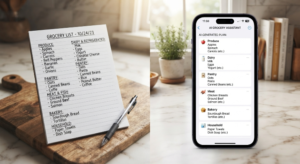
Once you have a weekly plan, AI tools can convert it into a consolidated grocery list, grouping ingredients that repeat across meals.
This step alone can save real time, since manually cross referencing five or six recipes for a shared shopping list is tedious. Ask the tool to organize the list by grocery store section, produce, dairy, pantry, and so on, so the list matches how you actually shop.
Adjusting Meals for a Budget
You can ask AI tools to suggest meals built around lower cost proteins, like beans, eggs, or chicken thighs, or to swap more expensive ingredients for cheaper alternatives with a similar role in the dish.
This works reasonably well as a starting point, though actual prices vary by store and region, so treat any specific cost estimate from an AI tool as a rough guide rather than a guarantee.
Prompting AI Effectively
A few practical prompt examples for weekly meal planning:
“Plan five dinners for two adults, no repeated proteins, each under 30 minutes, using mostly pantry staples.”
“Here is what is already in my fridge: chicken thighs, spinach, rice, and canned tomatoes. Suggest three meals using these ingredients.”
“Turn this list of five dinners into a single grocery list organized by store section.”
“Suggest a vegetarian meal plan for one week that stays under a modest weekly grocery budget, using mostly beans, eggs, and seasonal vegetables.”
The more specific the constraints, household size, time limits, dietary needs, and what you already have, the more usable the output tends to be.
Checking AI Generated Information
This is the step most people skip, and it matters most for anything involving nutrition or food safety claims. AI tools can produce confident sounding information that is inaccurate.
The Federal Trade Commission has directly warned consumers about this, noting that chatbot responses can be inaccurate, inadequate, misleading, or made up, and recommending that people verify any answers by searching online or checking with a reputable source.
This is particularly relevant for meal planning if you ask an AI tool about food safety timelines, specific nutrition figures, or allergen information.
Cross checking those specific claims against a source like the USDA or a registered dietitian resource is a reasonable extra step before relying on them.
Avoiding Unrealistic or Repetitive Plans
Left unchecked, AI generated meal plans can drift toward repetitive suggestions or assume more cooking time and skill than you actually have. If a plan feels unrealistic, it is worth going back and refining the prompt rather than accepting the first output.
Asking directly for “meals a beginner cook could make in under 20 minutes” produces very different results than a generic request.
Keeping Human Judgment Involved
An AI generated meal plan is a draft, not a final decision. You still know your own schedule, your family’s actual preferences, and what you already have half used in the fridge better than any tool does. Treat the output as a starting point to edit, not a plan to follow exactly as written.
Privacy Considerations
When using AI tools for meal planning, be mindful of what personal information you share, especially in tools connected to broader accounts or health data.
Sticking to general preferences, dietary style, household size, rough budget, rather than sharing detailed medical information, is a reasonable default unless you are using a tool specifically designed and trusted for that purpose.
Verifying Nutrition and Food Safety Claims
AI generated nutrition information is not always reliable, particularly for specific numbers.
Research on AI generated health information has found meaningful rates of inaccurate or incomplete answers even in tools designed with reference sources built in, which is a useful reminder that specific numeric claims from an AI tool are worth double checking before they inform a health related decision.
If a meal plan involves managing a specific health condition or allergy, that verification step becomes especially important.
Turning an AI Output Into a Practical Grocery List
Once you have reviewed and adjusted the plan, ask the AI tool to reformat it as a grocery list, then do a final check yourself: cross off anything you already have, add pantry staples the AI might have assumed you already own, and confirm quantities make sense for your household size before you shop.
Illustrative Example
Consider a fictional reader, Owen, who used an AI chat tool to plan dinners for a week while managing a tight grocery budget. His first prompt produced a plan repeating chicken breast four nights in a row.
After refining the prompt to specifically ask for varied proteins and a consolidated grocery list, the second attempt produced a much more usable weekly plan, which he then adjusted slightly based on what was already in his pantry.
CONCLUSION
Learning how to use AI to plan your weekly meals comes down to treating the tool as a fast first draft generator, not a finished planner.
Give it specific constraints, check anything related to nutrition or food safety against a reliable source, and adjust the output based on what you actually know about your own kitchen and schedule.
Used this way, AI can meaningfully speed up the planning process without replacing the judgment that makes a meal plan actually work for your household.
FAQS
Is AI meal planning actually reliable?
It can be a useful starting point, but AI generated information, especially around nutrition and food safety, should be checked against a reliable source before you rely on it.
Do I need a paid tool to use AI for meal planning?
No. Many general purpose AI chat tools can generate a usable weekly meal plan and grocery list without any specialized meal planning subscription.
How specific should my prompts be?
Very specific. Include household size, time constraints, dietary needs, and what ingredients you already have for the most usable results.
Can AI help me plan meals on a budget?
Yes, AI tools can suggest lower cost proteins and ingredient swaps, though treat any specific price estimate as a rough guide rather than an exact figure.
Should I trust AI generated nutrition information?
Treat specific nutrition numbers with caution and verify them against a trusted source, particularly if you are managing a specific health condition or allergy.
Can AI create a grocery list from my meal plan?
Yes, and this is one of the most genuinely time saving uses of AI in meal planning, especially when you ask it to organize the list by store section.
Is AI going to replace regular meal planning entirely?
Not based on current evidence. AI works best as a drafting tool that speeds up planning, while human judgment still shapes the final decisions.